
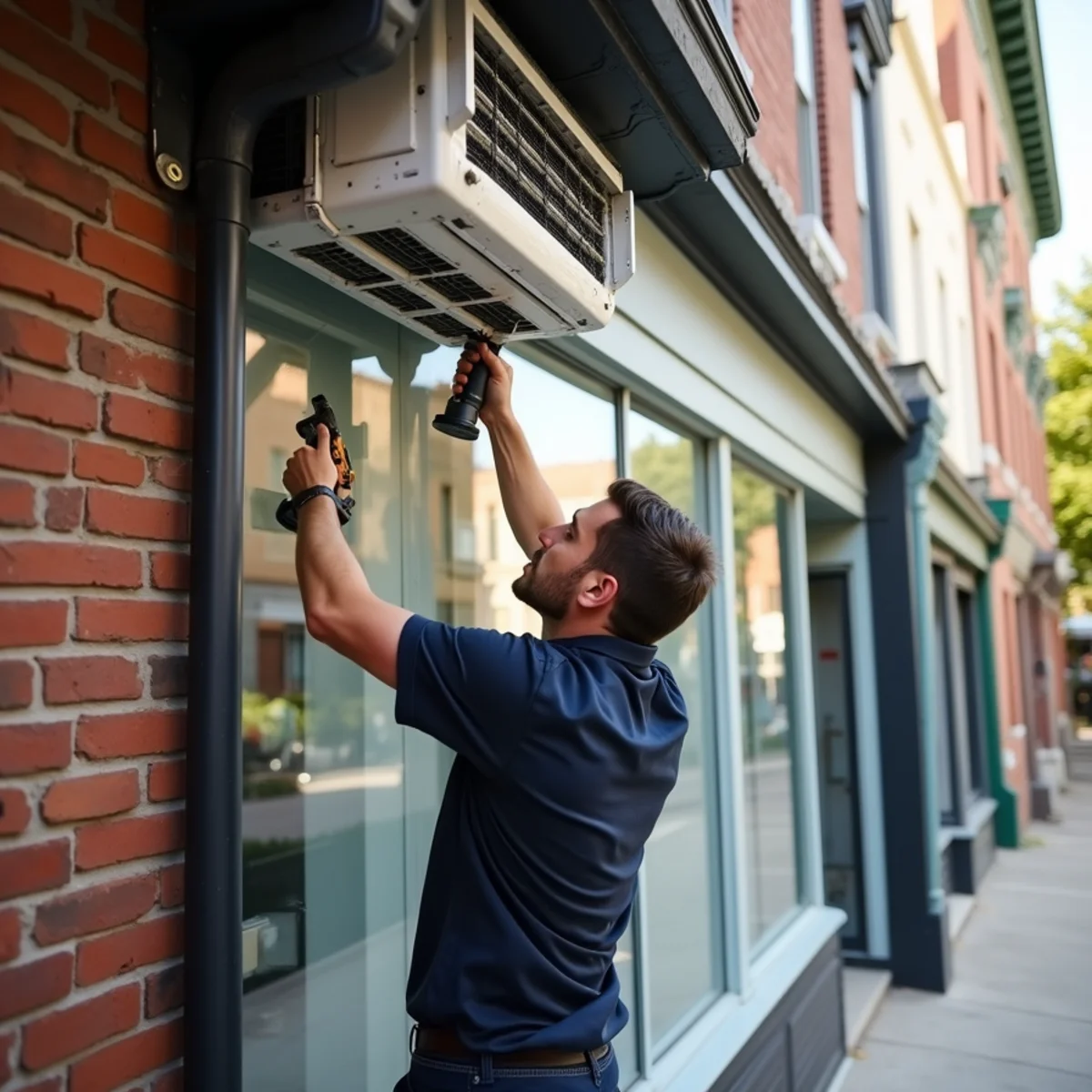
This stretch of brick Victorians and rowhomes above ground-floor shops is one of the trickiest heating and cooling environments in the borough. Mixed commercial-and-residential use, shared party walls, and buildings that predate central ducting all change how we diagnose and quote. We know these structures because we work in one every day.
The Buildings We Service Along High Street
Most of the district is late-19th-century masonry — three-story brick fronts with retail at street level and one or two apartments stacked above. Many still run on old boilers feeding cast-iron radiators, and plenty have never had a true duct system installed. Retrofitting central air into solid brick with plaster walls is rarely practical, which is why we lean on ductless mini-splits for cooling and supplemental heat up here.
When a building carries both a shop and apartments on one meter or one aging boiler, sizing and zoning get complicated fast. We run a Manual J load calculation on each occupied space instead of guessing from the old equipment, then map out where a mini-split head or a right-sized boiler makes the most sense without tearing into historic finishes.
The shared party walls between these attached buildings add another wrinkle. Heat and moisture move between units, a neglected boiler two doors down can leave your storefront cold, and one thermostat rarely satisfies a whole three-story building. We treat each occupied floor as its own zone with its own load, so the coffee shop at street level and the apartment two floors up are not fighting over a single undersized system. We also plan line-set and vent routing around the district's masonry and its exterior-review constraints before we quote, not after.
Rooted in the Historic Core
Because we operate out of the district ourselves, we understand the constraints the NRHP listing puts on visible exterior work and the reality of running line sets through century-old masonry. That is not a textbook problem for us — it is our daily commute.
This past spring a landlord two doors down called after tenants in a second-floor apartment complained the space never got comfortable and the old boiler was flooding the rooms with heat. We added a two-zone ductless mini-split for efficient cooling and shoulder-season heat, tucked the line set along an existing chase so the brick facade stayed untouched, and left the owner an itemized quote before a single tool came out. The tenants finally had control of their own thermostat, and the landlord kept the building's character intact.
We also keep the ground-floor businesses along High Street running. A storefront that loses cooling in July or heat in January is losing customers, so we prioritize commercial no-cool and no-heat calls in the district and carry common rooftop-unit and split-system parts on the truck. Being able to walk the block means we can look at a problem, quote it honestly, and get the shop comfortable again the same day more often than not.
Why High Street Historic District homeowners choose HVAC Pottstown PA
We are not a call center dispatching a stranger across the county — our address is 530 E High Street, inside the district you live and work in. That proximity means faster arrivals, and it means we already understand how these mixed-use brick buildings behave before we knock on the door. Fifteen-plus years of working on High Street's boilers, radiators, and retrofit mini-splits is experience you cannot fake, and it shows up in a diagnosis that gets to the real problem instead of guessing.
Every job here comes with a written, line-item quote after an on-site diagnosis, so a landlord juggling a storefront and two apartments knows exactly what each fix costs. We are licensed and insured, EPA Section 608 certified, and we pull the Pottstown mechanical permits that historic and mixed-use work requires. When a tenant's heat quits at midnight, our 24/7 emergency line is answered by the same local company you see on the block every day.
- Based inside the district at 530 E High St — often on-site within minutes
- Ductless mini-split expertise for brick rowhomes with no ductwork
- Separate zone sizing for storefronts and the apartments above them
- Line sets and venting routed to protect the historic masonry and facade
- Licensed, insured, EPA 608 certified, and we pull Pottstown mechanical permits
- 24/7 emergency service for downtown no-heat and no-cool calls
HVAC Services in High Street Historic District
From no-heat emergencies to full system replacements, here's how we help homeowners and businesses in High Street Historic District:
Need HVAC service in High Street Historic District today?
Call HVAC Pottstown PA for fast, honest HVAC service in High Street Historic District. We answer 24/7 and offer same-day service across Montgomery County.
HVAC FAQs — High Street Historic District, Pottstown
Usually a ductless mini-split is the smarter path. Solid masonry and plaster walls make retrofitting ductwork expensive and invasive, while mini-splits cool and heat efficiently with a small line set and no major demolition.
Yes. We service ground-floor commercial spaces and the residential units above them, and we size each zone separately so a storefront and an apartment are not fighting over one undersized system.
Our shop is inside the district at 530 E High Street, so we are often on-site within minutes. We also run a 24/7 emergency line for no-heat and no-cool calls.
We plan every job to protect the masonry and finishes, routing line sets through existing chases and keeping demolition to zero wherever possible. We also account for the exterior-review constraints that come with the NRHP-listed district.
Yes. We repair cast-iron radiator and boiler systems, check the circulator, expansion tank, and near-boiler piping, and can right-size a replacement boiler that keeps your existing radiators in service when the old unit finally gives out.
Serving High Street Historic District from Our Pottstown Base
just a couple of minutes on foot from our shop at 530 E High St
HVAC Pottstown PA
530 E High St, Pottstown, PA 19464